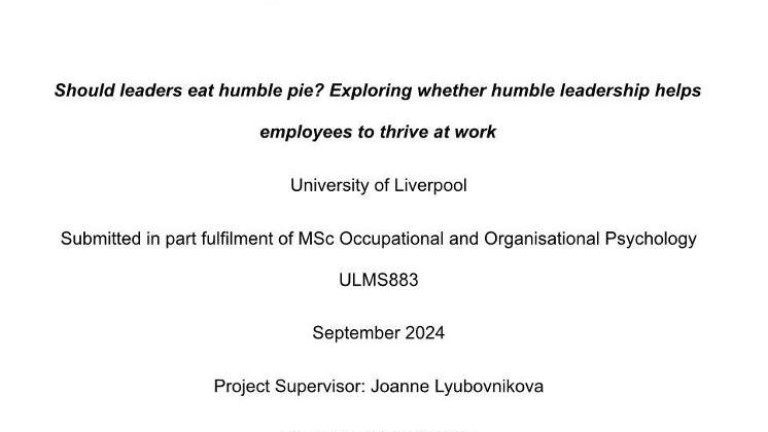
I am incredibly proud to share that my son Dan James has completed his dissertation to finish his Masters in Occupational and Organisational Psychology.
He has worked extremely hard on this over the summer - I know it has been challenging at times, and he has shown great resilience and determination to get this over the line.
The abstract (below) is a great teaser, and I am really looking forward to reading it in full.
Based on the abstract, I am sure that there will some great insights, that I will be able to bring to my work.
I suspect I will need Dan to explain some of the research methods!
I will share more once I have the opportunity to understand and digest.
Abstract
Leadership has evolved as the world of work has changed in recent decades. Transitions such as increased acknowledgement of human capital in organisations has meant that leaders have shown increased levels of humility by means of prioritising employee experience of work.
Humble leadership has since grown into its own discrete leadership style. However, research literature on this style of leadership has delivered inconsistent findings, as well as being predominantly conducted on samples from Asia, meaning its effectiveness in Western cultures is unclear.
Humble leadership has not before been researched in its relation to thriving at work, an advantageous individual workplace outcome, which has been shown to benefit on individual, group and organisation levels. Also, humble leadership’s focus on instilling autonomy generated the postulation that psychological empowerment may influence its relationship with thriving at work. Further, the power distance level perceived by employees was predicted to influence this whole interaction, due to its association with leadership, and influence on psychological empowerment.
Therefore, the current study proposed a moderated-mediation model to test these predictions. An online quantitative questionnaire was completed by 138 participants to collect data for analysis. The questionnaire consisted of four scales, each assessing a study variable. The sample included a comprehensive representation of individuals from different genders, ages, organisation sizes, and job roles.
Using the data collected, regression analyses found significant positive correlations between humble leadership and psychological empowerment, and psychological empowerment and thriving at work. Psychological empowerment was also found to mediate the relationship between humble leadership and thriving at work. Finally, low and average level power distances were found to strengthen the relationship between humble leadership and psychological empowerment.
The dissertation supports the perspective that humble leadership offers beneficial outcomes, through providing novel findings of its association with these concepts. Practical and theoretical implications are also identified, such as considerations of how to develop humility in managers.